

T–250 WEEKS
Test day is coming.
For this first year, I’m organizing my training into seven-week blocks. Six weeks of training, followed by a lighter seventh week that ends with a test.
For now, that test is simple: one hour on the rowing machine.
No looking at pace. No heart rate. No numbers telling me to speed up or slow down.
Just row for an hour as well as I can.
By feel.
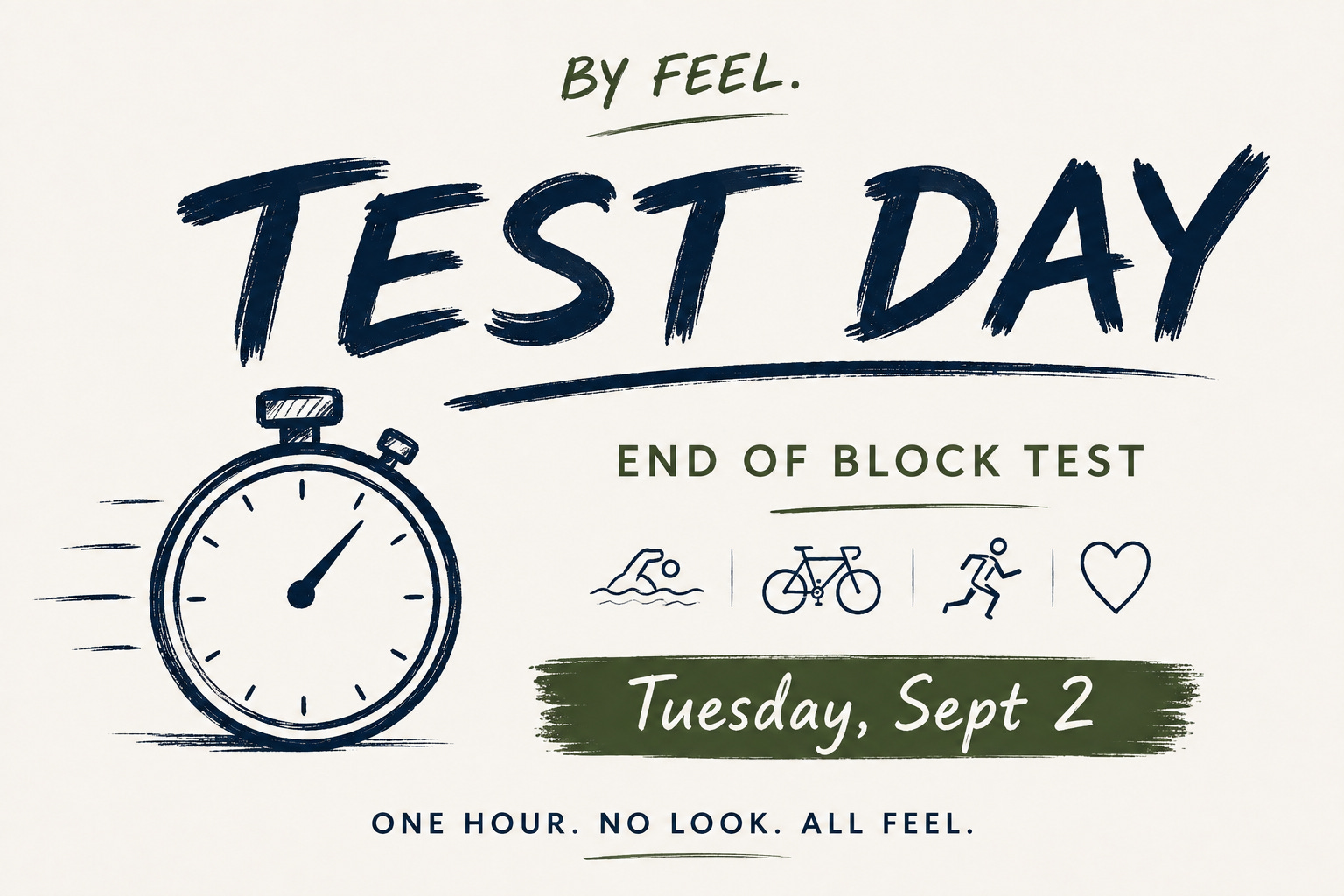
There are a few reasons I like this structure.
The obvious one is that the test gives me a marker. Do the same thing every seven weeks and, over time, I should get a pretty good idea of whether my fitness is actually improving.
But I’m becoming just as interested in what happens before I see the result.
Training without seeing the numbers forces me to pay attention.
How hard am I breathing? How do my legs feel? Is this effort sustainable? Is that little ache something to ignore or something telling me to back off? Do I have more to give?
I’m trying to get better at hearing those signals rather than having a number make the decisions for me.
And every once in a while, my body surprises me.
A workout feels comfortably strong, I finish, look at the monitor—and discover I was going considerably faster than I thought.
I love that.
Test day takes the same idea and raises the stakes a little.
I have to choose an effort in the opening minutes that I think I can sustain for an hour. I have to decide whether to push harder later. And I have to make all of those decisions without knowing whether I’m rowing 2:25 or 2:40.
That’s not just a fitness test.
It’s practice.
Because eventually I want to race the same way.
I don’t want race day to be the first time I ask my body, What can you do today? I want years of experience answering that question.
Of course, let’s maintain some perspective here.
One hour on a rowing machine is far, far, far from the duration of fitness I’ll eventually need for an Ironman.
This is the beginning of the beginning.
But that’s another reason I like these tests. I don’t need Ironman fitness today. I need to find out whether the fitness I have today is becoming better than the fitness I had seven weeks ago.
So, what do I think will happen?
My prediction:
2:34/500m
ChatGPT, which has been helping me keep my training log, is more bullish:
2:31/500m
Here’s what it has to work with.
Over the last six weeks, my rowing has gradually moved forward:
Aug 1 — 60 min, Middle 30 min: 2:30/500m
Aug 15 — 60 min, Overall: 2:43.3,Middle 30 min: 2:39
Aug 22 — 60 min, Overall: 2:39, Middle 40 min: 2:29
Aug 27 — 30 min, Middle 10 min: 2:27
Aug 29 — 45 min, Middle 15 min: 2:24.5
There have been plenty of deliberately easy rows mixed in too. But those harder sections are why ChatGPT thinks I might be underestimating myself.
But the interesting part isn’t whether I’m right or ChatGPT is right.
It’s whether my body is right.
Can I sit down, ignore the monitor, listen to what I’m feeling and find something close to the best hour I’m capable of that day?
I’ll find out when I finally look at the screen.
What’s your prediction: faster or slower than 2:34?
Feel good.